AEROHYGROPRO – Study of Aerosol Hygroscopic Effects on Optical and Microphysical Properties Using Remote Sensing Techniques
- Reference: PZ00P2 168114
- Funding agency: Swiss National Science Foundation (SNSF)
- Principal Investigator: Francisco Navas Guzmán (MeteoSwiss, Switzerland)
- Project period: 01/09/2017 – 28/02/2021
- Total budget: 409,215.00 CHF
Atmospheric aerosols represent one of the largest sources of uncertainty in the assessment of anthropogenic impacts on climate. Aerosol particles interact with solar radiation and modify cloud microphysical properties, influencing both direct and indirect radiative effects. A key factor controlling these processes is relative humidity (RH), as many aerosol particles undergo hygroscopic growth by absorbing water vapor, leading to changes in particle size, optical properties, and their ability to act as cloud condensation nuclei (CCN).
Despite its critical importance, aerosol hygroscopicity remains insufficiently characterized using remote sensing techniques, mainly due to the lack of simultaneous, vertically resolved observations of aerosol properties and relative humidity. Most previous studies have been limited to short-term field campaigns or isolated case studies.
AEROHYGROPRO aimed to significantly advance the understanding of aerosol hygroscopic growth by exploiting long-term, quasi-continuous remote sensing observations. The project was based on a multi-instrumental approach centered on the Raman Lidar for Meteorological Observations (RALMO), operated at the MeteoSwiss aerological station in Payerne. RALMO is one of the very few Raman lidars worldwide providing continuous measurements of aerosol optical properties and atmospheric thermodynamic profiles over more than a decade.
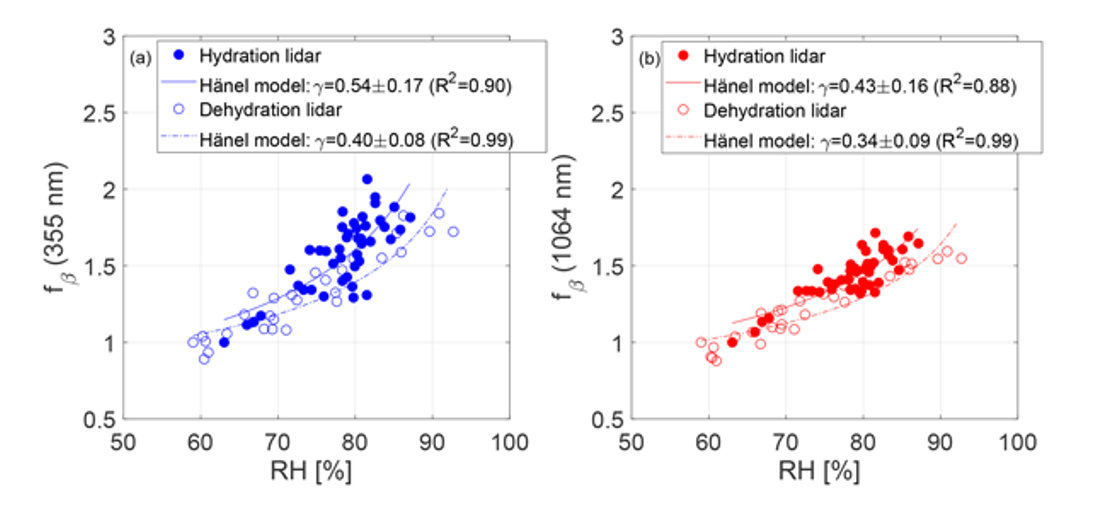
Using this unique dataset, vertically resolved aerosol optical and microphysical properties were retrieved and statistically analyzed to quantify hygroscopic growth factors as a function of relative humidity for a wide range of aerosol types, including Saharan dust, volcanic particles, anthropogenic pollution, and biomass burning aerosols. Remote sensing results were evaluated through comparisons with ground-based hygroscopicity measurements obtained from nephelometer systems with controlled humidity, as well as in situ aerosol size distribution and chemical composition observations during dedicated Intensive Observation Periods (IOPs).
Expected impact
AEROHYGROPRO provided one of the most comprehensive remote sensing-based characterizations of aerosol hygroscopicity to date, based on long-term and vertically resolved observations. The project delivered robust growth factor estimates for multiple aerosol types, improving the representation of aerosol–radiation and aerosol–cloud interactions in climate models.
By demonstrating the capability of Raman lidar systems to quantify aerosol hygroscopic effects under real atmospheric conditions, AEROHYGROPRO contributed to reducing key uncertainties in aerosol climate forcing assessments. The results supported the validation of remote sensing methodologies and strengthened the integration of ground-based observations with in situ measurements.
Overall, the project represented a significant step forward in advancing non-invasive techniques for aerosol characterization and provided valuable insights for climate modeling, cloud process studies, and the interpretation of aerosol observations from both ground-based networks and satellite missions.